


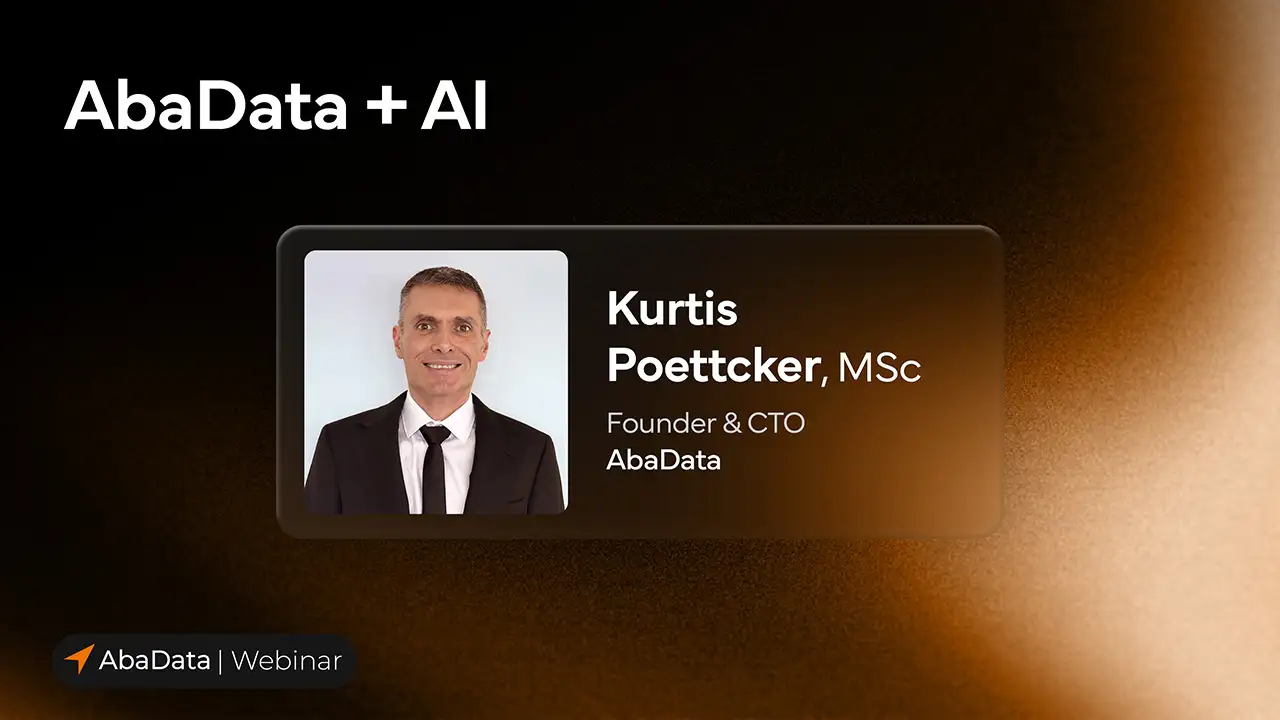



Watch our live discussion on Artificial Intelligence in energy operations. In this session, we explored how AI works, how it’s evolving across the industry, and how AbaData is applying it to help users access insights faster and more intuitively.
In this session, we introduce the fundamentals of artificial intelligence and explore how it is being applied within AbaData to simplify reporting and uncover insights from complex energy data. Through a combination of discussion and live examples, we walked through how AI can enhance existing workflows and what it means for the future of energy operations.
A brief introduction to AI and how it is transforming data-driven workflows across the energy industry.
See how artificial intelligence is being integrated into the AbaData platform to simplify reporting and accelerate insight discovery.
Learn how users can move from manually built reports to asking questions in plain English using AbaData’s AI Assistant.
Free to attend
Live demonstration
Recording available after the event
Stephanie Verity
"Good morning, everyone!
Hey there, my name is Stephanie Verity. I am the lead of customer success here at AbaData. I’m going to be your host for today’s session, and thank you guys so much for joining us today.
We have over 800 users registered for today’s, first session, and this is part one of our two-part series exploring how AI is being integrated into AbaData.
So, before we get started today, we just have a couple of housekeeping items to note.
This session is being recorded, and we’re going to be sharing the recording via email with all of our registrants afterwards.
And during the session today, we encourage you to submit questions.
There’s a Q&A panel at the bottom of your screen that you’ll find there.
And we’ll leave time at the end of the session to go through some questions together.
Anything that we don’t get to today, we’ll be sure to follow you… follow up with you via email afterwards.
So, at AbaData, we’ve been building purpose-built software for oil and gas operations for over 25 years.
Throughout that time, our focus has always been on helping our users better access, understand, and act on their data.
And now I’d like to do… introduce today’s presenter.
Kurtis Poettcker is the Founder and CTO of AbaData.
Since founding AbaData, he has led the development of software platforms that have become essential tools across North America’s energy and utilities industries.
Under his leadership, AbaData has built one of the most comprehensive energy software platforms in the world, and we serve nearly 30,000 users.
With deep expertise in GIS, software development, and energy data systems, Kurtis continues to drive innovation, including the integration of AI into AbaData’s next generation of products.
So today, he’ll be walking us through how AI is being applied in AbaData, and what that means for the future of reporting and our data workflows.
And with that, Kurtis, I’ll hand it over to you."
Kurtis Poettcker
"Thanks, Stephanie.
And thanks for the, the great introduction."
Stephanie Verity
"You bet, we’re excited to hear your session today."
Kurtis Poettcker
"Awesome.
For those of you who haven’t had the pleasure of getting to know Stephanie, she leads the customer success team out of Red Deer, and the work that those guys are doing to support the AbaData users is world-class, and just really, really appreciate the opportunity to get to work with Stephanie, and and yeah, wanted to call her out.
As part of this, part of this webinar.
We will get started here.
I’ll share my screen.
And… Hopefully everybody can see that.
So, AI and AbaData, A big topic, a topic that you…
well, not so much the AbaData part, but AI, you can’t really avoid if you’re anywhere in the world today.
It’s… it’s coming up.
More and more, from…
Mattress stores claiming AI advantages, all the way to the top tech leaders in the world.
It is a hot topic of conversation, and so we felt it was maybe time to,
Put out a bit of an informative session on, sort of, our stance as a company.
where we stand, where we’re going, and how we’re making AI available to our users, and in order to enhance our products.
As I mentioned,
AI is everywhere, there’s… there’s a lot of really loud voices, there’s a lot of…
Fear-mongering, there’s a lot of… Anxiety, around all of this, and…
I hope that our intent today is to be absolutely none of those.
We are…
hoping to be a voice of reason in the conversation of AI, and where it’s going, and where we’re taking it in industry and with our tools.
So with that, let’s get started here.
There we go.
Bit of an agenda for today.
I’m gonna do a really high-level introduction into AI,
As far as how we’re referring to it as part of this webinar, now AI obviously is a very large and deep topic.
We won’t be getting into
extreme technicalities or very low levels here, but definitely want to sort of set the stage and…
make sure everyone understands where we’re coming from when we talk about the term.
Follow that up with how we’re using it today at AbaData.
We’ll talk a little bit about customer-facing use, as well as internal use inside of our organization.
Close it out with… I think a really… powerful example.
the efficiencies that could be gained by incorporating AI into our software.
And then, I think, as Stephanie mentioned, we’ll take a couple of questions from the audience, so if you have a question as we sort of present, please note that in the question box on… as part of the Zoom webinar.
And we will pick a couple of those, to answer at the end.
So if that sounds good, we can… we can get started.
So, as I mentioned, the first step, we really need to define what we as an organization here at AbaData mean.
when we talk about AI, and again, I’m talking specifically about this particular webinar, and… and…
as it relates to this webinar, we’re defining AI as a tool that
allows humans to interact with computers in a much more human manner than has previously been available, so…
Traditionally, if you’re looking to communicate with a computer.
A software developer is involved, code is written, and outcomes are produced during that, traditional…
Development lifecycle process that, that occurs.
AI very disruptive to that, and is making that interaction a lot more human-like, where you’re really able to have conversational interactions.
With, with computers, and… and that involves things, like asking and understanding questions, analyzing data.
And most importantly, I think, is generating results off of both of those interactions, so…
That’s, again, very high level.
what we’re referring to in this webinar by AI.
Now, what it looks like in practice.
Mention this a little bit, but…
Really, it’s what most of you are probably doing on a daily basis with tools like,
Gemini and ChatGPT, where you just simply pull up a prompt.
Ask a question, and you get an answer.
Really sort of modernizing the…
the previous Google experience that we’ve sort of all participated in, where when we need information, we no longer
ask a search engine to find it, we’re asking AI for those answers.
A little bit deeper than that, though, we’re also talking here about not just prompting, but actually uploading data sets.
In order to gain insights into them, so…
Definitely another, another area of, of AI and in practice.
And those two combined, what we’re really getting at here, is the opportunity to explore data without having to write code to perform that exploration.
Really democratizing that experience of…
Presenting a dataset, and asking questions of it, and getting that response back in real time.
As you’re… as you’re interacting.
At AbaData,
we are viewing AI as a tool, nothing more, nothing less, to really enhance productivity, and deliver much more meaningful results
Both to our employees internally, and to the users of our software externally.
And really assisting both of those parties in getting the information that they’re looking for in as efficient of a manner as possible.
That’s our, our sort of internal approach.
What we’re really not interested in, and what we’re really not talking about here.
Is, you know, in my mind, the most important bullet point here is that first one, replacing people.
It’s really not a strategy that we’re employing to reduce our headcount.
As you’ll see if you’re… if you spend any time on our website, we’re actively hiring, really across all fields here.
And so that’s… that’s not what we’re talking about when we’re talking about AI here.
It’s also not a magic black box.
It’s not a… Instrument that can be…
have garbage thrown at it, and gold returned.
This is… this is not sort of in the realm of… of where we’re at, or where our software tools are going at this point, so…
It’s an important point that we’ll stress on a little bit later, is it’s really able to…
take valuable and well-intentioned prompts and provide excellent responses to those prompts.
So, not a magic black box, and it’s also not a shortcut or a way to subvert expertise.
We’re not looking at it as a replacement to SMEs or anything like that.
Again, I’ll go back to the tool analogy.
It’s… it’s… it’s no different than you might, you might use a hammer,
Hammer in the hands of an unexperienced person is going to have very mixed results.
A hammer in the hands of a…
very experienced carpenter, can do just incredible things, and really, we’re looking at AI no differently.
It’s… it’s about… freeing, users of AI and allowing them to do meaningful work.
It’s really not about, about replacing those people.
Another…
Very important topic that needs to be discussed, and we don’t have time to dive really deep into it, but
Our stance on customer data remains unchanged.
Since we started AbaData in the early 2000s, we’ve held the principle that customer data belongs to customers.
It does not belong to AbaData, and the way we use it needs to reflect that state of ownership.
AI doesn’t change that conversation at all.
We never use customer data to train any public AI models that are available.
We are not in the business of selling that information or putting it out into the public sphere for broad consumption.
It’s something that we have always taken very seriously, and we continue to take very seriously.
the examples we’re gonna get into, inside of AbaData.
All are related purely around public data, and…
When you get right down to the sort of weeds, we’re not even… we’re not training models off of that public data.
We’re training models on our database schema and allowing them to understand where to go to get the information to answer the questions that users are asking.
So, it’s a very, very different conversation, but rest assured, we’re not in the business of
Exposing customer data, to… to the public.
Our focus here really, really is on empowerment.
So, I said it again, I’m gonna say it, or I said it before, I’m gonna say it again.
We’re not in the business of using AI to reduce workforce.
We’re really in the business of allowing
staff and users, to utilize AI to eliminate a lot of the menial tasks that they’re performing, and focus on that high-value work
That people want to be doing.
There’s not a lot of fun as a software developer in copying and pasting 500 lines of code and changing one character on each of those lines.
That’s the type of efficiencies that we’re gaining by incorporating
AI into our workflows here, here at AbaData.
I have a quote there at the bottom, from our CEO, Jason Taves.
something I strongly believe in, and something that we focus on very, very heavily here at the company.
And that is, people will not be replaced by AI, but by people using AI.
Again, it’s a tool, if we go back to the Hammer reference, it’s no different.
than saying builders are going to be replaced, by builders using hammers.
That’s really kind of the, the sentiment behind, behind our, our stance there.
I mentioned it’s not a black box.
We’re not talking about magic.
There is a requirement from the user, and it’s… it’s a very important and specific requirement, and that is…
Asking the right question, it can’t be… it can’t be said enough.
the better the prompt, the easier that the AI model is able to interpret what the user is asking.
The better the results are going to be from that prompt.
AI is only able to answer the questions that it’s given.
We have a developer here that I think has coined the term automagic.
maybe I’m wrong, it’s very possible, but AI is not automagic.
It’s not automagically able to do anything.
You’re really a very important part in the whole cycle of prompting.
Before we get too, too deep into specifics, I just wanted to introduce the people on this webinar to our amazing AI engineering team.
Matthew Mann, Kallin Kehrig.
Matthew’s in our Calgary office, Kallin’s in our Regina office.
The work that these two individuals have done in the AI realm over the last few years is truly world-leading and world-class.
Hmm… Also, gonna take this opportunity to have a bit of a shout-out here.
We are actively investing into this team.
And trying to recruit as many talented engineers as we can find to join these two individuals.
So, anybody on the call is in that world and is interested, we’d be more than happy to accept resumes and have a conversation.
But again, the work… We’re about to focus on here is really the…
the output of these two amazing guys working here, that I’ve definitely had the privilege of working with, every interaction with them is always a real opportunity to learn.
And there’s a lot of excitement as well, so this is very exciting work, and those two are the right guys to be doing it, so…
couple of examples here about…
where we’re using AI today inside of AbaData, and then we’ll transition to sort of our future roadmap.
As far as customer-facing interactions go, we really have two that are out there today.
both of them sort of are under the same umbrella, and that’s what we’re calling our AI Assistant.
Now, internally, we have, I think, a much cooler name for this.
We call it AbaChatta, but the public-facing side of it is AI Assistant, and you’ll see it.
Some of you may have already seen it in AbaData, but it’s going to be more and more prevalent, and hopefully after we go through the demo.
All of you will find more reason to use the tool as well.
The other part of that AI Assistant
Is, performing advanced analytics on regulatory data sets.
And that’s something we’re going to demo here today, which is really changing the game on how we develop software here at AbaData.
We’ve already completed some real-world use cases.
The results can be viewed today through AbaData.
One of them is,
Our connectivity algorithm and our pipeline network building tool.
So, automating the process of connecting wells to pipelines, pipelines to facilities, and flowing those molecules through those networks, and collecting them where they need to be collected, so…
If there’s interest in anyone on the call looking into that, please get ahold of us.
We’re happy to walk through
Walk you through that, that process.
We’ve also undertaken several projects that have involved
The parsing of scanned hard copy forms.
And what I mean by parsing here is…
We’re taking hand, scanned hard copy forms, and those could be handwritten notes, they could be PDFs of existing forms that were completed.
We’re, running those through an AI model agent, Not just to digitize.
but to digitalize the data that’s on there.
So understanding The intent behind the document.
and converting it into our data schema for data storage and analysis later on.
So, that’s also a very interesting, application, that, again, more information is available on.
We have our pipeline integrity tool.
It’s been using artificial intelligence and machine learning for several years.
It’s another way that we’re using it through existing products.
You’re able to really analyze
Previous failures that have occurred in industry, and learn from those results and apply them to today’s operational pipelines in order to create an informed risk assessment
On, on pipeline infrastructure.
And then finally, with our Field Ops tool, we’re using AI to analyze that data that’s coming in from the field, and perform really advanced recommendations and analytics on that data.
And, and making that, making that available to Field Ops customers.
Behind the scenes, we’re using AI internally.
We’ve developed a, internal knowledge base, so an internal
Chatbot, if you will.
For employees to access information relative to their jobs and to the company.
If an employee has a question about…
who owns the GIS process inside of AbaData?
It’s able to give those answers and provide guidance, to our ever-expanding staff here, as, we need
to expose them to more and more of the company, it’s a great way to do that.
we’re also using it as a development team.
on a daily basis, to do a lot of that work that I was mentioning before, the automation of those very mundane tasks that are involved in software development.
Still owning the development process as humans.
But again, accessing that tool in the tool belt to make ourselves more efficient.
I already mentioned this, AI Assistant.
Is, is, is really our, our, our user-facing,
AI agent, to… that’s incorporated into AbaData.
And we’ll get into examples of how that’s done.
And the example’s gonna focus largely on reporting.
And how we’re able to go, really, from
a week’s long, and I’ve exaggerated here for a bit of effect, but a weeks-long process to mere minutes or seconds even, in that reporting process.
Where we’re going next, sort of on our roadmap.
We’re interested in leveraging AI more with our Field Ops collected data, so…
A lot of companies are out there.
Digitizing data from the field using a forms-based application.
That’s…
what we do with Field Ops, but it’s not where our main interest lies in Field Ops.
That work is easy, simple to perform.
Where the real magic comes in is now analyzing that collected data and using the results of that analysis to inform companies
About how to better improve efficiencies and lower costs at the field level.
We’re also looking at getting a lot deeper in map-based interactions, so you’ll see there’s a couple map interactions with AI Assistant today.
We’re looking at improving those and making those a lot more meaningful.
What we’re really doing is moving from storing data to allowing users to understand and act on that data.
So, enough talking, let’s, let’s start looking at a real example here.
And I already mentioned it, we’re gonna tackle reporting, and just see how AI has changed
the, the game in relation to reporting, specifically.
So…
Picture yourself as a user, most of you, most of you are, so it should be a fairly easy process.
you need a report that currently isn’t possible to pull inside of AbaData.
We don’t have the parameters, the UI isn’t set up.
This is your workflow.
You email support, or call them, either one, they prefer phone calls, but I understand a lot of people are email.
You wait for a response.
There’s often a clarification conversation that needs to happen.
You wait again.
And eventually, the, the report is built into the interface, and you’re able to access it through AbaData.
So what does this look like behind the scenes?
Well, that customer support that you interacted with.
They are taking those… requirements, relaying them to the development team.
Where, they’re… interpreted.
attempted to be applied, there’s often… this loop often goes back and forth a few times, where there’s questions from development that need to be passed off to support, which, again, needs clarification from the customer.
So, this cycle, goes back and forth, sometimes several times, before even work starts.
Once we have things more or less hammered down.
we start development.
So, as a development team.
We need to build a UI to handle the parameters of this new report.
We also need to build out the report logic, so we need to wire up all the connections in order to
generate the results that are expected as part of that report.
This process needs to happen custom every time a new report is asked for.
Once development is finished.
It then goes to our quality assurance, quality control team, makes sure that it works and functions the way it’s supposed to, there’s not a lot of bugs in it.
It then has to be queued up and waited for the next release cycle, where it finally makes its way into production.
Now.
even us as doing daily releases, we’re still really looking at a week here on sort of a best-case scenario.
Worst case scenario, as I said, it’s gonna be, it’s gonna be longer than that.
It gets out to production, you’re a user, you’re super excited to see your new report, you go in and use it, and you realize
You forgot you wanted one more parameter added to that report.
Well…
guess what?
You have to go back, essentially, and repeat, the entire steps 1 through 3, which I think
we can all agree on is not the most efficient, workflow that’s possible.
Again, best case, we’re talking days, I would guess, average, about a week of work.
Not… sorry, not a week of work, a week of time
passes between request and delivery.
And in every iteration, that, that total time has to, has to reset.
So, what if we were to change one thing in that, development lifecycle.
What if the reporting worked more like a conversation, as opposed to a development task?
With our AI Assistant, this is now being possible.
You as a customer are now able to interact directly with the chatbot, which is our AI Assistant, in order to get your results.
There’s no handoffs, there’s no game of telephone being played, and there’s no delays.
You’re able to access your data.
Real time, as you’re asking requ… as you’re asking questions.
A little bit of compare and contrast here.
Traditional reporting, we’ve already gone through it.
Multiple teams involved.
A large, time investment.
You still end up with fixed reports, and the whole process is very hard to iterate.
We plug AI into this process.
It’s really just you as the user now.
We’re dealing in seconds as opposed to days.
It’s incredibly flexible, and you get instant iteration on your reporting, so…
You don’t request reports to be created for you anymore, you just get the opportunity to explore your data.
Why this matters should be obvious.
Faster answers, better decisions, Bottlenecks have been removed.
And we’re really looking at a true self-service opportunity where users are empowered to get access to the answers they need out of their data.
I think that line at the bottom is great.
The biggest change here isn’t speed, although the speed improvements are incredibly impressive.
It’s the freedom, it’s the ability to
ask the questions you want, and get the answers, and iterate incredibly quickly on that process.
So, let’s dive into AbaData.
And get this demo started.
I’ll just switch over here to AbaData.
Hopefully, all of you are familiar with
AbaData 3 at this point.
We recently, changed the mapping behind.
Looks, I think, a lot more
Modern, and more what users are expecting to see in a map.
If I’m here to pull a report.
And say I’m interested in a pipeline report.
Today, I go into Reports, I click on Global.
And I go to my pipeline section, and maybe I want to, access a report of Alphabow pipelines, so I add Alphabow to the report.
And I come down, and I’m interested in Alphabow pipelines that have a wall thickness of 3.2 millimeters.
Come down to my parameters, and…
there’s no wall thickness available in the global reports inside of AbaData.
So, I need to kick off that traditional,
software development lifecycle that we illustrated before, unless I start switching the way I work and access this now through the AI Assistant.
So the AI Assistant…
Available on the bottom right corner of your screen.
And it looks very similar to any AI prompt that you’re used to working with.
Where there’s just a text box to ask a question.
So I would come up here and start saying, what Alphabow pipelines have a wall thickness of 3?
3.2 millimeters.
And here go, I spelt, I spelled thickness wrong there, but luckily our engineers have accounted for that, and our AI Assistant is able to understand typos and what the real meaning is behind them, so…
It’s now going out, it’s interpreting my request.
And starting to prepare that report.
Based on the request parameters that I’ve asked here.
So, in a couple of seconds there, I get my response.
You can see it here for yourselves.
I’ve identified 1,691 pipelines, licensed to Alphabow with a wall thickness of 3.2 millimeters.
Now.
Historical data being what it is, there’s probably a range that you could have specified in there, which is why it’s said here exactly 3.2 millimeters.
There’s a bit of a table here just outlining those results.
You get a nice pie graph of those results if you’re interested.
In this case, it’s chosen to graph them based on status, but you could ask for any type of graph to be created for you.
Gives you a little bit of a preview here.
And then finally, there’s a button at the bottom to download the full dataset.
So that full data set of results in Excel can be downloaded by clicking on that button.
Now, here’s where we get to the item that we forgot.
So, forgot to… that I also only wanted
Materials, Z245.1.
again, no need to reenact the development lifecycle.
I can just simply come in and say, actually, I only wanted pipelines… sorry, I’ll try to type this one better for you… with a material type…
of Z245.1.
And a wall.
Thickness, and sorry, I realize I’m doing a horrible job here of trying to look at a screen and type at the same time, so I’m just going to…
make a change here, because I think that’s an important
important word.
Again, garbage in, garbage out.
Hit submit on that request, and it’s now gonna go through and adjust to that change that I’ve made in my report request.
It mentions updating that report for you.
It’s now recognizing, okay, I’ve added the request of material type here, which we didn’t have before.
The AI Assistant needs to adapt to that, change its queries.
And you’ll now see a new result set of 1,664 segments that meet that category.
So.
Same layout as before, you’ve got a breakdown of those by status, you’ve got a sample set of the data for you to explore, and if you’re happy with it, the ability to download that Excel file to your computer to work with in whichever way you see fit.
That’s it.
Really, process, process finished.
It’s as easy as that.
Again, if I wanted to continue to iterate on this, I absolutely could.
But for all sense and purposes, that report has now been completed.
I have a few more examples, and I’m not gonna subject everyone to the pain of watching my typing, so I’ve pre-canned them in my sort of search history.
And that can be accessed in AbaData by clicking on this full screen button that’s at the bottom below the prompt window.
If I click on that, the AI Assistant now takes the full screen, and you’ll see on the left-hand side here a history of my different requests that I’ve made.
So we’ll just go through a couple of these.
I think it gets to illustrate some very important points, in the process here.
Maybe I won’t.
It is not recognizing my click as I go through, so let’s just try to get back into it here.
Here we go, perfect, sorry about that.
The first request here
I prompted, you can see at the top there, the highest producing wells in Rocky View County.
So here you see a bit of an interaction between a spatial data set that lives in AbaData with the counties.
and the production, that’s attached to the wells.
So the AI Assistant has gone through.
And, created the results.
And if you go through it here, you’ll notice that the,
Top producing wells in 2024 are identified below.
And as you go through, you’re able to download all of these different reports that have been created, from that particular request.
Another one that I’ve mentioned, what pipelines are on my screen right now?
So, before I mentioned, that we have some map interaction, between AbaData and…
Our AI Assistant, but it’s not complete.
So you’ll see I just clicked there on this 10, 25, 20, and it zoomed me there.
But really, the AI Assistant didn’t know what was on my screen.
That’s on our roadmap.
That’s where we’re going.
So I did have to specify with a clarifying prompt that I was looking at section 102520, and then it returned the results, again, graphed out.
In this case, it shows outside diameter, but I can download that entire report for that particular section.
I’m going on…
I put this one in there, really just to illustrate that the AI chat assistant here
is really confined to only AbaData-related requests.
So, this request for a banana bread recipe, unfortunately, was unable to be… to be resolved, so you’ll have to take that request to another AI agent.
If we click into here, to look at the next one, what report… what well reported the highest single, production, monthly production.
And sorry, we have… A bit of a holdup here again.
I’ll see if I can get this back.
production, and it looks like, the dangers of…
Live demos have, have struck again.
And so, I’m not gonna maybe be able to,
demonstrate some of the other examples that I wanted to.
There are some very powerful
examples of prompts here, and resulting requests, including this one at the bottom, where I really asked about…
about a well, and how it delivers its product to a facility.
And the AI Assistant was able to identify the pipelines.
That needed to be, used in order to get that product from the well to the facility.
As well as flow rates through those pipelines, histories of no flows, all of that can be identified, with the, with the chats, as they, as they appear.
On, on the AI Assistant.
We have about 5 minutes left now.
I’ll turn it back over to Stephanie, and we can maybe field a couple of questions that have come in."
Stephanie Verity
"You bet.
Thanks, Kurtis, that was great.
So yeah, we did have some questions come in, throughout the webinar today.
So we’ll just take a few minutes to answer some live.
So, the first question that we have, is, the following.
I think everyone has experienced the frustration of dealing with a chatbot that returns answers slash options which don’t include what we are asking or needing.
Do you have any advice on how to best use it?"
Kurtis Poettcker
"Yeah, great question.
It goes back to really what I was mentioning about, the garbage in, garbage-out statement.
AI assistants, AI chatbots, are not human beings.
They’re using the…
the data that’s been used to train them to interpret what the user is requesting and craft a response.
If it’s a request that it has not seen in the past.
There’s gonna be a struggle to craft the proper response to that request.
And so often, rewording or rephrasing questions is a great way to get around that.
There’s also, on our AI Assistant, below every response, the ability to react to that response.
A negative reaction
will be fed to that AI engineering team that I mentioned before, which will be used to really improve the expected behavior of the AI Assistant, and make the subsequent responses a little bit more intuitive to the users."
Stephanie Verity
"Okay, great.
And another question that we have that came in, does AbaData contain water well data that AI could search out water wells deeper than 150 meters depth, and could AI find the chemistry of those water wells?"
Kurtis Poettcker
"Yeah, another great question.
As of today, we have exposed our AI Assistant to our entire inventory of datasets at AbaData.
So, astute users will notice, will know that we have the water well data inside of AbaData, and the chemistry data is there as well.
As well as the depth of the well.
the AI Assistant is absolutely able to access that data, query it in just the manner that’s being requested, here below, or in that question, and output the results, accordingly.
So, long answer, short answer is yes, that, that can absolutely be achieved today in AbaData."
Stephanie Verity
"Awesome, thanks, Kurtis.
Well, everyone, that’s all the time that we have for today, but thank you again for joining us for today’s webinar.
As mentioned, this was just part one of a two-part series, so be sure to mark your calendars, because our second session is going to be coming up on April 21st.
And, you can find more information about that by following us.
Look on LinkedIn, it’s also going to be on our website as well.
As we mentioned previously, everybody who’s registered for this webinar today is going to receive a copy of the recording.
And if we didn’t get to your question during the session today, we are going to be following up with everybody to just make sure that you have the answers that you need.
So, feel free to reach out to us anytime that you have questions or concerns.
I believe that we are going to drop a link to where you can contact our support team below.
And yeah, we’d love to hear from you, so, yeah, please reach out if you have questions.
And thank you everybody again for joining us, and hopefully we’ll see you all again on April 21st."
Kurtis Poettcker
"Thanks, everyone."
Kurtis Poettcker is the founder and CTO of AbaData. For more than 25 years, he has led the development of software platforms that have become essential tools across North America’s energy and utilities industries. Under his leadership, AbaData has built one of the most comprehensive energy data platforms in the region, serving nearly 30,000 users.
With deep expertise in GIS, software development, and energy data systems, Kurtis continues to drive innovation at AbaData, including the integration of artificial intelligence into the company’s next generation of products.

Learn how AI-powered AbaData software is transforming operations across the industry.
Explore